

A "free" website platform is rarely free. For a nonprofit or association where one person manages the website alongside fundraising, communications, events, and operations, the real cost of a free or cheap platform is paid in staff hours: the manual workarounds, the tasks that should take two minutes and take twenty, and the time spent fighting a backend that was never designed for a non-technical team. WordPress carries a $0 license. Wild Apricot starts around $1,500 a year. Neither number is the real number.
This post is not about design or features. It is a cost-accounting exercise.
We are going to name the recurring tasks that quietly consume staff time on low-cost platforms, give you a simple framework to estimate the hours, and show you how to convert those hours into a dollar figure you can put in front of a board. Then you can run your own math and decide whether "free" is actually the cheapest option you have.
10-20 hrsper month of workaround labor we see organizations spend on cheap or "free" platforms |
$0-$1,500the sticker price that hides that labor, from WordPress's free license to Wild Apricot's entry tier |
1 formulato convert your staff hours into the real annual cost of your platform |
Quick answer: The real cost of a "free" or cheap website platform is the staff time it consumes, not its sticker price. In our audits, nonprofits and associations on low-cost platforms spend 10 to 20 hours a month on workarounds: entering brand colors by hex code because there is no saved palette, rebuilding content blocks that cannot be cloned, reformatting images by hand, managing plugin or theme updates, and syncing member data between the website and a separate tool.
To find your true cost, use this formula:
Real annual cost = sticker price + (monthly workaround hours x 12 x staff hourly value) + annual developer or contractor fees.
A comms director at a $60,000 salary is worth roughly $40 an hour fully loaded, so 15 hours a month of workarounds is about $7,200 a year in staff time alone, on top of whatever the platform and its plugins cost.
Why the Sticker Price Is the Wrong Number to Compare
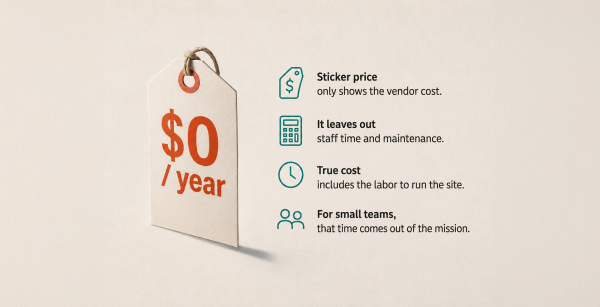
The sticker price of a website platform measures what you pay the vendor. It does not measure what you pay your own staff to keep the site running. For a small nonprofit or association team, the second number is almost always larger than the first.
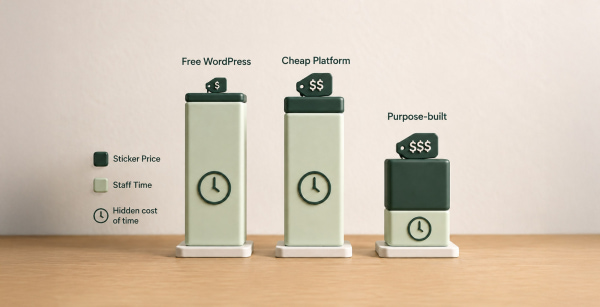
When a board compares website platforms, it usually compares sticker prices: WordPress is "free," Wild Apricot is about $1,500 a year, a purpose-built managed platform is $3,000 to $5,000 a year. On that comparison, the cheap option always wins. But the sticker price only counts the vendor invoice. It ignores the largest cost line for a small organization, which is the time your own people spend operating the platform.
Total cost of ownership (TCO) is the accounting term for this: the full cost of a tool over its life, including purchase price, maintenance, and the labor to run it. For enterprise software, TCO is standard practice. For nonprofit and association websites, it almost never gets calculated, which is exactly why the "free" platform keeps winning the argument and keeps costing the organization thousands in unbilled staff time.
The reason this matters more for mission-driven organizations than for a business is staffing. A company can assign a developer to maintain a WordPress site as part of their job. A nonprofit with a two-person office cannot. The maintenance burden lands on a communications director or an executive director whose time is the organization's scarcest resource, and every hour they spend reformatting an image or chasing a plugin conflict is an hour not spent on the mission.
"When I audit a 'free' website, the first thing I add up is not the plugin licenses or the hosting. It is the staff hours. I ask the person who manages the site to walk me through a normal week of updates, and I time it. Almost every time, the organization is spending more on the labor to run a free platform than it would spend on a platform that eliminated the labor. They just never put a number on it, so it stayed invisible."
- Brent Lafreniere, Digital Director
Reviewed by Our Team
This post draws on website audits of low-cost platforms across nonprofits and associations, and on the analytics work that reveals where staff time is actually spent.
 Brent Lafreniere, Digital Director (Audit & Migration Experience) - 19 years in digital across schools, nonprofits, associations, and healthcare. Audits low-cost and "free" platforms for the hidden labor cost, and leads migrations for organizations that decided the staff time was no longer worth it. Provides the time-cost patterns and the audit framework in this post.
 Steven Calibo, Digital Strategist (Analytics & Digital Strategy) - 15 years in digital strategy spanning all four Morweb verticals. Google Analytics, Google Ads, HubSpot, and CRO certified. Uses analytics tools to show where staff effort is going and which recurring tasks consume the most time. Provides the measurement approach for quantifying workaround labor.
What Tasks Actually Consume the Staff Time?
The staff time on a cheap platform does not disappear into one big project. It bleeds out through small, recurring tasks that each take a few extra minutes and add up to hours every month.
When we audit a low-cost platform, the same handful of tasks come up again and again as time sinks. None of them are dramatic. That is exactly why they stay invisible: no single task feels expensive, so nobody adds them up. Here are the ones we see most often.

The Recurring Time Sinks We Find in Audits
- Entering brand colors by hex code, every time. On platforms with no saved brand palette, staff paste a hex value like #1a2b3c by hand every time they add a button, a heading, or a background. Get one character wrong and the brand color is subtly off across the page.
- Rebuilding content blocks that cannot be cloned. A staff person builds a nice event card or a donation callout, then has to build it again from scratch for the next event because there is no way to duplicate it. Purpose-built platforms let you clone a block in one click.
- Reformatting images by hand. No built-in cropping or resizing means opening a separate image editor, exporting at the right dimensions, and re-uploading, for every photo.
- Fighting an unintuitive backend to make a simple edit. The change is small. Finding where to make it is not. Staff describe hunting for the right screen as "a needle in a haystack."
- Managing plugin, theme, or software updates. On WordPress specifically, someone has to run updates, check that nothing broke, and troubleshoot conflicts when it does. (We cover this failure mode in depth in our WordPress post, linked below.)
- Syncing member or donor data between two systems. When the website and the membership or email tool do not talk to each other, someone exports a spreadsheet from one and imports it into the other, by hand, on a schedule. This is the single biggest time sink we see on the association side.
- Rebuilding formatting after the editor breaks it. Paste from Word, watch the formatting scramble, fix it manually. Every time.
Individually, each of these is a two-to-ten-minute annoyance. Collectively, across a month of updates, events, and content changes, they are where the 10 to 20 hours go. The platform is not broken. It is just quietly transferring work onto the one person who can least afford it.
Why Cheap Association Platforms Cost the Most in Staff Time
Associations feel the hidden-labor problem more sharply than most nonprofits, because an association website is not just content. It is membership, dues, events, and a member directory, and on a cheap platform those systems rarely talk to each other.
Wild Apricot is the price anchor in almost every association conversation we have. At roughly $1,500 a year for a small organization, it looks like a bargain against a purpose-built platform. But association executives consistently describe the individual features as, in their words, "very mediocre," and the gaps get filled by staff labor. The event registration is clunky, so someone rebuilds it in a separate tool. The email is limited, so member data gets exported and imported by hand. The website editor is rigid, so branding gets done manually.
This is the association-specific version of the "free" trap: the platform is cheap because it is thin, and the thinness is paid for in staff hours. A membership director who is also running events, sending the newsletter, and updating the website does not have 15 hours a month to spare on data exports and workarounds, but that is what a thin platform quietly demands.
Real Morweb association clients face exactly this operational reality. The Microscopy Society of America runs an annual meeting, publishes journals, and supports student and early-career members, all of which touch membership, events, and content that have to stay in sync. The Greater New York Automobile Dealers Association serves franchised dealers with advocacy, training, and member services, and produces the New York International Auto Show on top of it. The Driving School Association of the Americas manages members across multiple countries plus an annual international conference. For organizations like these, a platform where the website, membership, and events live in separate systems is not a saving. It is a standing labor bill.
"On the association side, the hidden cost is almost always data movement. If your website does not know who your members are, someone on staff becomes the integration. They export from one system and import into another, every week, forever. When we measure it, that manual sync is often the single most expensive recurring task in the whole operation, and it exists only because the cheap platform could not do it natively."
- Steven Calibo, Digital Strategist
How Do You Calculate the Real Cost of Your Platform?
You calculate the real cost by adding the vendor sticker price to the value of the staff time the platform consumes, plus any developer or contractor fees. The formula is simple, and the number it produces is usually a surprise.
Here is the framework. It takes about 30 minutes and a recent timesheet or a good estimate. Run it once and you will never look at a "free" platform the same way again.
The Time-Cost Formula
Real annual cost = Sticker price + (Monthly workaround hours x 12 x Staff hourly value) + Annual developer/contractor fees
Step 1: Write down the real sticker price
Not just the license. Add the annual total of: the platform subscription (if any), premium plugin or add-on licenses, hosting, SSL, security or backup services, and any separate tools you pay for because the platform cannot do the job (a separate email tool, a separate event tool, a separate form tool). For a "free" WordPress site, this line is frequently $500 to $1,500 a year once plugins, hosting, and security are counted. It is not zero.
Step 2: Estimate monthly workaround hours
Use the task list from the section above. For one month, either track it or estimate honestly: how many hours does the person managing the site spend on updates, formatting, rebuilding blocks, syncing data, and fighting the backend? In our audits this lands between 10 and 20 hours a month for organizations on thin or "free" platforms. Use your own number if you have one.
Step 3: Set the staff hourly value
Take the annual salary of the person managing the site, add roughly 25 to 30 percent for benefits and overhead to get the fully loaded cost, then divide by 2,080 (the number of work hours in a year). A $60,000 salary is roughly $75,000 fully loaded, which is about $36 an hour. Round to $40 for simplicity.
Step 4: Add developer or contractor fees
If you pay someone outside the organization for changes you cannot make yourself, at $75 to $150 an hour, add the annual total. Many organizations forget this line because the invoices are irregular. Pull a year of them.
Step 5: Add it up
Put the three numbers together. The example below shows how a "free" platform routinely lands north of $8,000 a year in real cost once staff time is counted.
|
Cost line |
"Free" WordPress site |
Cheap platform (~$1,500) |
Purpose-built managed |
|
Sticker + tools/plugins/hosting |
$800/yr |
$1,500/yr |
$4,000/yr |
|
Staff workaround time (15 hrs/mo x $40) |
$7,200/yr |
$7,200/yr |
~$1,900/yr (5 hrs/mo) |
|
Developer/contractor fees |
$1,500/yr |
$600/yr |
$0 (included) |
|
Real annual cost |
~$9,500/yr |
~$9,300/yr |
~$5,900/yr |
The figures above are an illustrative model using the audit ranges in this post, not a quote. The staff-time and workaround-hour ranges reflect what we see in audits; your numbers will differ. The point is the shape of the comparison: the platform with the highest sticker price often has the lowest real cost, because it eliminates the labor.
What Changes When the Platform Absorbs the Labor
The value of a purpose-built platform is not that it is cheaper on the invoice. It is that it moves the recurring work from your staff to the platform, so the hours the audit found go back to the mission.
When the platform has a saved brand palette, one-click block cloning, built-in image handling, native donations and events, and managed hosting and updates, the task list from the audit largely disappears. The comms director is not entering hex codes or rebuilding event cards or exporting member lists. That is the entire point of the higher sticker price.
Real Morweb clients across both verticals run their sites on exactly this model. New Opportunities, a Connecticut community-action agency that served 37,351 individuals in 2025 across dozens of programs, manages a large, program-heavy site without a developer on staff. Turning Point, a New Jersey treatment provider with nine programs and 144 residential beds, keeps a complex services site current through the same visual editor. On the association side, AAHomecare maintains an advocacy-driven membership site where policy content, member resources, and events stay in one place instead of scattered across separate tools. In each case the staff time that a thin platform would have consumed is not being spent, because the platform, not the person, carries the load.
"The measure I care about after a migration is not the design. It is how many hours a week the site takes to run. When an organization moves off a thin platform, the recurring workaround time usually drops by two-thirds or more, because the tasks that ate the hours, the manual formatting, the rebuilt blocks, the data syncing, simply stop existing. That reclaimed time is the real return on the higher sticker price."
- Steven Calibo, Digital Strategist
Common Mistakes When Costing a Website Platform
Most organizations undercount the cost of their current platform in the same few ways. Each one makes "free" look cheaper than it is.
- Counting the license and forgetting the labor. The biggest cost line for a small team is staff time, and it is the one line that never appears on an invoice, so it never enters the comparison.
- Treating staff time as free because it is already paid. The salary is fixed, but the hours are not free. Every hour on a workaround is an hour not spent on fundraising, programs, or members. That is a real opportunity cost.
- Forgetting the separate tools. The email tool, the event tool, the form tool, and the design tool you pay for because the platform cannot do those jobs are part of the platform's real cost. Count them.
- Ignoring irregular developer invoices. Because contractor charges come in unpredictably, they get mentally excluded. Pull a full year of them and add the total.
- Assuming the cheap option scales. A thin platform that is manageable at 100 members or 20 pages becomes a labor sink at 500 members or 200 pages. The workaround hours grow with the organization.
How to Run Your Own Time-Cost Audit This Week
You do not need a consultant to find your real cost. You need one month of honest tracking and the formula above.
- Log the hours for one month. Ask whoever manages the site to keep a simple tally: task, minutes, date. No special tools, a notepad works.
- Categorize the time. At month end, group the tasks: formatting, updates, rebuilding, data syncing, backend hunting, contractor coordination. This shows where the time concentrates.
- Pull the real sticker price. Add up every website-related invoice from the last 12 months: subscription, plugins, hosting, security, and separate tools.
- Run the formula. Sticker price + (monthly hours x 12 x staff hourly value) + annual contractor fees. Write down the number.
- Compare against a managed alternative. Ask any purpose-built vendor for an all-in annual price, then compare real cost to real cost, not sticker to sticker.
If your real cost comes in well above the managed alternative, you have the business case. The next step is making that case to the people who approve the budget, which we cover in the board post linked below.
The Real Cost of a Free Website Platform: Common Questions
Is a free website platform ever actually the cheapest option?
Yes, in narrow cases. A free platform is genuinely cheapest when the organization has a technically capable person managing the site as part of their role, a small and stable set of features, and no need to sync membership or donor data across systems. For most small nonprofit and association teams, none of those conditions hold, and the staff time to operate the "free" platform exceeds the cost of a managed one.
How many staff hours does a cheap website platform really cost?
In our audits, nonprofits and associations on thin or "free" platforms spend 10 to 20 hours a month on workarounds: manual formatting, rebuilding content blocks, resizing images, running updates, and syncing data between systems. At a fully loaded staff rate of around $40 an hour, 15 hours a month is roughly $7,200 a year in staff time, on top of the platform and plugin costs.
How do I calculate the total cost of ownership of my website?
Use this formula: real annual cost equals the sticker price (subscription, plugins, hosting, security, and any separate tools) plus monthly workaround hours multiplied by 12 and by your staff hourly value, plus annual developer or contractor fees. Staff hourly value is the fully loaded salary (base plus about 25 to 30 percent) divided by 2,080 work hours.
Why does Wild Apricot cost more than its price suggests?
Wild Apricot's entry pricing of roughly $1,500 a year looks inexpensive, but association staff routinely describe its individual features as limited and fill the gaps with manual labor: rebuilding event registration in a separate tool, exporting and importing member data by hand, and working around a rigid editor. That labor is the hidden cost. When you add it to the sticker price, the real annual cost is often close to what a fuller platform would charge outright.
Isn't staff time free since we already pay the salary?
No. The salary is fixed, but the hours are a finite resource with a real opportunity cost. Every hour a communications director spends reformatting an image or syncing a member list is an hour not spent on fundraising, programs, member engagement, or communications. On a small team, that reallocation of time is the most expensive thing a thin platform does.
How much staff time does a purpose-built platform actually save?
It varies by organization, but the recurring workaround tasks (manual formatting, rebuilt blocks, image handling, data syncing, and update management) largely disappear when those capabilities are native to the platform. Organizations that move off a thin platform typically see their recurring website labor drop substantially, which is the return that justifies the higher sticker price.
More on evaluating the true cost of your website platform:
Membership Management Software: What Associations Actually Need. What to look for when the website, membership, events, and member data need to live in one system instead of several.
The Best Nonprofit CMS for 2026: WordPress vs. Drupal vs. Joomla vs. Morweb. Compare usability, maintenance, security, support, and built-in functionality when evaluating the long-term cost of your CMS.
Semi-Customized Nonprofit Websites vs. Hiring a Web Designer. See how platform choice affects upfront cost, ongoing maintenance, staff dependency, and the total resources required to manage your website.

What is your "free" platform really costing you?
Our team will walk through your current platform, the recurring tasks your staff performs, and the tools you pay for on the side, then give you a straightforward real-cost estimate using the framework in this post. You will get a number you can take to your board. No pitch unless you ask for one.