
Your nonprofit’s website isn’t just a digital brochure — it’s your most powerful storytelling and fundraising tool. It’s where donors decide whether to give, volunteers choose to sign up, and supporters learn how you’re making a difference.
A professional, accessible, and easy-to-update website builds trust and credibility — but how do you get there without overspending or overcomplicating things?
In 2026, nonprofits typically face two main options:
- Hiring a custom web designer or agency to build from scratch, or
- Using a semi-custom nonprofit website platform like Morweb to balance quality, flexibility, and affordability.
Let’s explore which is right for your organization and how to make the most of your online presence this year.

1. Should you build a nonprofit website from scratch or hire a web designer?
What this involves
A fully custom website means creating everything from the ground up — layout, structure, coding, integrations, and ongoing maintenance. While this offers full creative control, it also requires significant resources.
Key technical components include:
- HTML, CSS, and JavaScript for design and interactivity
- Mobile-responsive frameworks for smartphones and tablets
- Accessibility compliance (WCAG 2.2 standards)
- CRM and donation system integrations
- Custom hosting, maintenance, and security management
When it makes sense
- Your nonprofit has complex needs (multi-chapter structure, advanced database integration, multilingual content).
- You have in-house technical staff or a dedicated web budget.
- You want a completely unique digital experience tailored to your brand.
Drawbacks
- High cost and long timelines — full builds can take months.
- Ongoing maintenance — updates often require developers.
- Potential over-customization — more complexity means higher upkeep.
Does it still make sense in 2026?
Yes — for large organizations with technical teams or complex integration needs. However, for small to medium nonprofits, the rise of modern nonprofit CMS platforms has made semi-custom solutions a smarter, more sustainable choice — offering professional design, donor-friendly tools, and easy content control without the steep price tag.
2. Are semi-customized nonprofit websites a modern, affordable alternative?
A semi-custom website built on a flexible nonprofit website builder like Morweb offers the perfect balance of professional design, control, and cost-efficiency. In 2026, nonprofits are choosing semi-custom platforms to launch professional, mobile-friendly, and donor-optimized sites faster — without the high costs of hiring a web designer.
These sites use pre-built frameworks designed specifically for nonprofits — then customized to match your brand, programs, and goals.
Benefits of semi-custom solutions
- Faster launch times — get online in weeks, not months
- Lower cost — far more affordable than custom development
- Easy content management — update pages, events, and blogs without coding
- Built-in donation and event tools
- Optimized for SEO, accessibility, and mobile performance
Essential features to look for in 2026
- Drag-and-drop design tools — edit layouts and add content effortlessly
- Integrated donation forms and CRM connectivity
- Automatic image resizing and compression for speed
- WCAG-compliant accessibility features
- Browser and device optimization
- Secure hosting and SSL certificates
- Built-in analytics and SEO tools
Why it works
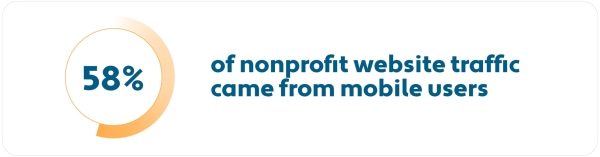
In 2026, over 58% of nonprofit website traffic came from mobile users, and 94% of visitors say design impacts trust. Semi-custom websites empower you to deliver a beautiful, trustworthy experience without needing to be a developer.
This approach also aligns with search engine best practices, helping your nonprofit website rank higher for relevant keywords like “donate,” “volunteer,” and your organization’s mission.
3. What are the key nonprofit website trends and statistics for 2025–2026?
|
Metric |
Latest Data (2025-2026) |
|
Mobile Traffic |
58% of nonprofit web traffic originates from mobile devices. |
|
Organic Search |
44% of website visits come from Google and other search engines. |
|
Online Giving |
13% of total donations are made online, continuing to grow yearly. |
|
Average Donation |
$145 (desktop) vs. $75 (mobile) — mobile optimization matters. |
|
Page Abandonment |
55% of visitors leave after 15 seconds if content isn’t engaging. |
|
Security |
1 in 4 nonprofits have faced a cyberattack — SSL and secure hosting are musts. |
4. How can nonprofits determine whether a custom or semi-custom website is the right fit?
|
Factor |
Custom Build |
Semi-Custom Platform |
|
Cost |
High |
Affordable |
|
Timeline |
Long (months) |
Fast (weeks) |
|
Maintenance |
Developer-dependent |
Easy for staff |
|
Flexibility |
Unlimited |
High (within structure) |
|
SEO/Accessibility |
Manual setup |
Built-in optimization |
|
Best For |
Large, complex orgs |
Small to mid-sized nonprofits |
|
Scalability |
High |
Moderate-High |
Tip: If your nonprofit’s priority is ease of use, professional design, and online fundraising performance, a semi-custom solution built on a dedicated nonprofit CMS like Morweb provides the best ROI.
5. How do you apply EEAT to build trust and credibility online?
Search engines and donors alike reward nonprofits that demonstrate Experience, Expertise, Authoritativeness, and Trustworthiness (EEAT).
Experience
Highlight real stories, photos, and testimonials that showcase your nonprofit’s on-the-ground impact. Include authentic visuals — not stock images — to build emotional connection.
Expertise
Publish well-researched content about your cause area, and include bios of team members, board members, and founders to show knowledge and credibility.
Authoritativeness
Link to credible partners, include media mentions or awards, and share your years of operation or total impact numbers.
Trustworthiness
Ensure your site uses HTTPS, has a visible privacy policy, clear donation transparency, and accessible contact information. Trust starts with security and openness — and your website is where that begins.
6. What are the key action steps for your 2026 nonprofit website strategy?
- Audit your website — check performance, accessibility, and mobile usability.
- Define measurable goals (e.g., +30% online donations, +20% volunteer sign-ups).
- Choose the right platform — prioritize user-friendly design and integrated donation tools.
- Focus on storytelling — real stories outperform statistics alone.
- Implement SEO fundamentals — clean URLs, metadata, image alt text, and fast loading.
- Track results — monitor analytics and conversions regularly.
- Keep content fresh — update success stories, images, and donation appeals quarterly.
- Ensure accessibility and security compliance — build trust and inclusivity.
7. The Verdict for 2026
Your website is your nonprofit’s digital home base — the hub for every campaign, story, and donor relationship.
In 2026, the best strategy is one that combines:
- Professional design and branding
- Ease of content management
- Strong SEO and performance
- Trustworthy and transparent presentation
Semi-custom solutions built on a nonprofit-specific CMS like Morweb empower you to launch a visually stunning, donor-friendly, and secure website without draining your budget or relying on developers.
With the right approach, your nonprofit can boost visibility, donor confidence, and long-term growth — all while staying focused on your mission.
Ready to Elevate Your Nonprofit Website?
If you’re planning a website refresh or starting from scratch, consider using a purpose-built nonprofit website builder designed for storytelling, accessibility, and fundraising success.
A modern nonprofit CMS platform like Morweb helps you create a site that’s easy to manage, optimized for SEO, and aligned with your cause — so you can spend less time on tech and more time making an impact.