Most lists of the best nonprofit websites reward the same things: a striking video, a bold color palette, a clever animation. Donors are asking different questions. What do you do? Does my gift make a difference? Can I trust you? And the people your nonprofit serves are asking one question: can you help me?
We build websites for nonprofits. So instead of ranking designs, we audited 21 nonprofit websites against those questions, from a regional food bank to an international relief agency. Nineteen are sites we built. Below is what the strongest nonprofit websites do differently, where even good sites slip, and a checklist you can run on your own site in half an hour.
|
21 nonprofit websites audited on September 30, 2026, from local food banks to international foundations |
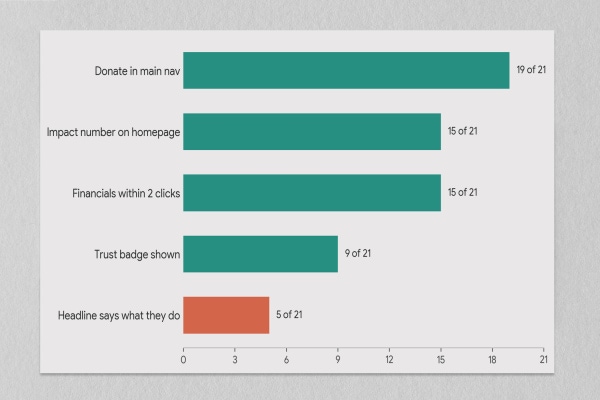
5 of 21 homepage headlines plainly say what the organization does and who it serves |
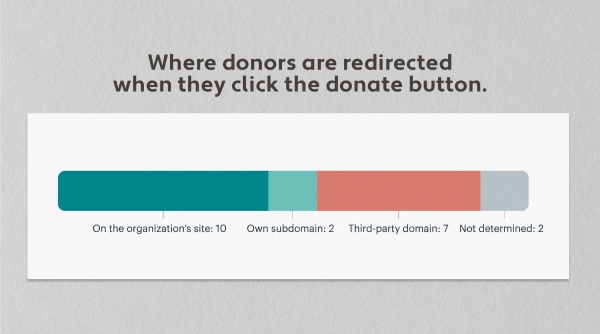
7 of 21 send donors to a third-party domain to finish their gift |
Quick answer: The best nonprofit websites do five things well: a homepage headline that says what the organization does and for whom, an impact number tied to what a gift achieves, a donation form that stays on the organization's own site, trust proof (ratings and financials) placed where donors decide, and a clear Get Help path for the people the nonprofit serves. In our 2026 audit of 21 nonprofit websites, most showed an impact number, but only 5 had a headline that plainly said what they do. A great nonprofit website answers the donor's first questions and the client's first question on the same screen.
How Did We Evaluate These Nonprofit Websites?
We scored 21 nonprofit websites on what donors and the people they serve look for first, not on visual style.
We started from the 30 sites in the previous version of this post, kept those that are nonprofits in the traditional sense, and added three Morweb clients whose sites show the patterns clearly. On September 30, 2026, we checked each homepage, followed the main Donate link, and looked for financial information. For each site we recorded:
- Headline: does the main homepage headline say what the organization does and who it serves?
- Donate path: is Donate in the main navigation, and where does the gift actually happen?
- Impact: is there a concrete impact number on the homepage?
- Trust: is a third-party rating shown, such as a Charity Navigator star rating or a Candid seal? Candid (formerly GuideStar) awards Bronze through Platinum seals to nonprofits that share information about their finances and results. Are the annual report or Form 990 reachable within two clicks?
- Help: is there a separate path for the people the organization serves, apart from donors?
Disclosure: 19 of these 21 sites run on Morweb. buildOn and the Elton John AIDS Foundation are not our clients, and we included them as outside benchmarks. We name organizations when describing what works. When a problem could embarrass a client, we describe the pattern without naming them, and we are working through the fixes with each organization.
Reviewed by Our Team
This audit was reviewed by three people who plan and design nonprofit websites, each from a different angle.
 Murad Bushnaq, CEO & Creative Director (Strategy, UX & Platform) - 25+ years in web design, 15+ focused on nonprofits, schools, associations, and healthcare. Founded the Morweb CMS and has guided 500+ sites, including United Way, Goodwill, and Engineers Without Borders USA. Works from a simple rule: strategy before technology.
 Bita Goli, Senior Designer (UX & Information Design) - 5+ years in UX, typography, and web design across all four of Morweb's verticals. Specializes in turning complex information into pages a first-time visitor can follow.
 Shawn Xiong, Art Director (Visual Trust & Accessibility) - 20 years in visual design and art direction, MFA in Graphic Design. Has led design on 30+ nonprofit and school sites, including Engineers Without Borders USA, Mercy USA, and MEND Poverty.
How Did 21 Nonprofit Websites Score?
Nonprofit websites are strong on impact numbers and Donate buttons, and weakest on plain-language headlines and keeping the gift on their own site.
|
Organization |
Headline says what they do |
Where the gift happens |
Impact number |
Trust badge |
Get Help path |
|
Yes |
On site |
Yes |
Yes, beside stats |
Yes |
|
|
Yes |
On site |
Yes |
Yes, home + donate page |
No |
|
|
Yes |
Third-party domain |
Yes |
No |
Yes |
|
|
Yes |
On site |
No |
No |
Yes |
|
|
Yes |
Third-party domain |
No |
No |
Yes |
|
|
Partly |
On site |
Yes |
Footer |
Yes |
|
|
Partly |
Not determined |
Yes |
Footer |
Yes |
|
|
Partly |
Third-party domain |
Yes |
Footer |
Yes |
|
|
Partly |
On site |
Yes |
No |
No |
|
|
Partly |
Not determined |
No |
No |
No |
|
|
Partly |
Own subdomain |
Yes |
Footer |
No |
|
|
No |
On site |
Yes |
No |
Yes |
|
|
No |
Third-party domain |
Yes |
Yes, in page |
Yes |
|
|
No |
Third-party domain |
Yes |
Footer |
Yes |
|
|
No |
Third-party domain |
Yes |
No |
Yes |
|
|
No |
Third-party domain |
Yes |
No |
No |
|
|
No |
On site (overlay) |
Yes |
No |
No |
|
|
No |
On site (overlay) |
Yes |
Footer |
No |
|
|
No |
On site |
No |
No |
Yes |
|
|
No |
On site |
No |
No |
Yes |
|
|
No |
Own subdomain |
No |
No |
No |
* Not a Morweb client; included as an outside benchmark. "No" under Get Help is expected for organizations that fund, advocate, or present rather than serve individuals directly. "Not determined" means we could not see where the gift happens without completing a donation.
Does Your Homepage Headline Say What You Do?
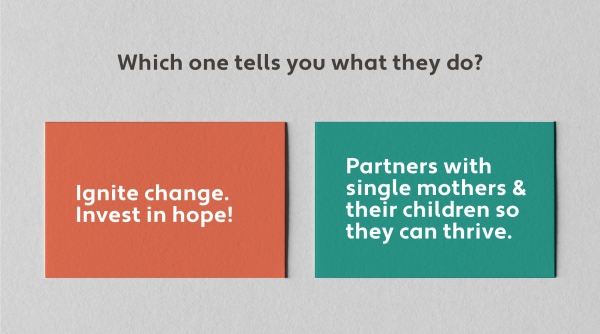
The best nonprofit homepages name what they do and who they serve in the first line; only 5 of the 21 we audited do it plainly.
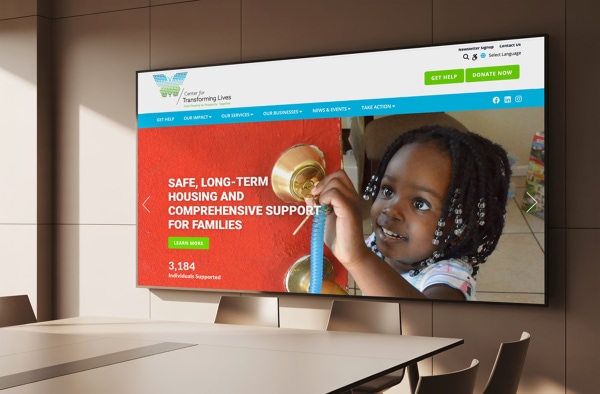
The clearest headline in the audit belongs to the Center for Transforming Lives: "Center for Transforming Lives partners with single mothers and their children so they can thrive." A visitor knows the work and the people in one sentence. Rainbow Community Care does the same for hospice: "Local hospice, palliative, and guided care for the ones you love." Red Panda Network says "We're protecting and restoring red panda habitat." MAHUBE-OTWA, a community action agency, speaks straight to one of the groups it serves: "MAHUBE-OTWA Can Help Parents With Young Children."
The weaker headlines fall into two groups. The first is the slogan: "Be The One." "Ignite change. Invest in hope!" "Pursuing Justice. Restoring Hope." Each is heartfelt, and none tells a stranger what the organization does. The second is the campaign slide, where the top of the homepage is given to this month's event, appeal, or report: a children's theater production, a hunger study, a seasonal giving campaign. That content matters, but when it rotates into the headline spot, first-time visitors never learn who you are.
The fix is not to drop the slogan or the campaign. Keep one fixed line that says what you do and for whom, then let the slogan and campaigns sit around it.
"A slogan is written for people who already know you. The homepage headline is for the person who doesn't. Before you pick a line that sounds inspiring, check whether a stranger could tell you, afterwards, what your organization actually does and for whom. If they can't, the line belongs somewhere else on the page."
- Bita Goli, Senior Designer
What Impact Numbers Should a Nonprofit Website Show?
The strongest impact numbers tell donors what their gift achieves, not only how big the organization is.
Fifteen of the 21 homepages show at least one impact number, which makes this the most common strength in the audit. The best ones go a step further and connect the number to the gift. The Fredericksburg Regional Food Bank says: "For every $10 donated, the FRFB is able to provide 20 meals." A donor can see exactly what $50 does. Mercy USA answers the efficiency question head-on: "96% of Donations Go to the Actual Cause."
Scale numbers work too when they are specific and dated. The Dayton Foundation shows "$1.5B Grants Awarded Since 1921." Red Panda Network shows "1,000,000+ acres of forest protected." HomeFront reports the number of individual people it supported.
Three details separate a credible number from a decorative one:
- Date it. "3,184 individuals supported in 2025" is evidence. "Thousands served" is a claim.
- Format it. On one site we audited, the headline stat displayed as a five-digit number with no comma. Small, but it reads like a database field rather than a result.
- Use the numbers you already have. One animal-welfare site keeps a full lifesaving-statistics page, but none of those numbers appear on the homepage. If you track it, put your best number where donors land.
Where Should the Donation Actually Happen?
Donors give with more confidence when the donation form stays on the organization's own website; 7 of the 21 sites we audited send donors to a different domain to finish.
Nineteen of the 21 sites put Donate in the main navigation. What happens after the click varies widely. Ten keep the gift on the organization's own site, either with a native form or a payment tool embedded in the page. Two use their own branded subdomain. Seven send the donor to a third-party domain run by the payment or CRM vendor, and the web address changes at the moment the donor is about to enter card details.
A third-party payment processor is not the problem. Most good donation forms run on one. The problem is the handoff: a different address in the browser, different styling, and sometimes a different organization name in the page title. buildOn, one of our outside benchmarks, shows the alternative: its donation form opens as an overlay on buildon.org, so the donor never leaves.
Community foundations face a harder version of this. The Community Foundation of Sarasota County manages many funds, and each fund's Give link goes to a separate page on its fund-management vendor's domain. That structure comes from how the funds are administered, and it is common across community foundations. It is still worth asking the vendor whether the form can be embedded or branded to match.
Two more findings from the donate path:
- Test the Donate link itself. On two sites, including one of our outside benchmarks, the main Donate link returned a "Page not found" page in our test. The giving tool may still load in some browsers, but a donor who sees an error page first is unlikely to try again.
- No one defaults to monthly. We could see the giving-frequency choice on six of the donation forms. All six offered monthly giving as an option, and none selected it by default. Our post on donation page mistakes covers why that default matters and how to change it.
"The moment a donor types a card number is the moment they are most alert to anything that looks off. If the address bar changes and the page suddenly looks like a different company, you've added doubt at the worst possible second. Keep the form on your site, or make the handoff look so much like your site that the donor doesn't notice it."
- Shawn Xiong, Art Director
Where Should a Nonprofit Show Its Ratings and Financials?
Trust badges work best next to the impact numbers and on the donation page; most nonprofits that earn them hide them in the footer.
Nine of the 21 sites display a Charity Navigator rating or Candid seal. Six of those nine put it only in the footer, where a donor deciding whether to give rarely looks. Three place it where the decision happens:
- Red Panda Network shows its Candid Platinum seal on both the homepage and the donation page, right where donors are deciding.
- Center for Transforming Lives places its Charity Navigator and GuideStar seals in the main content beside its impact numbers, so proof and results are read together.
- Turning Point displays its Candid seal and CARF accreditation in the page body.
HomeFront holds both a 2026 Candid Platinum seal and a four-star Charity Navigator rating, among the strongest credentials in the audit, and shows them in the footer. Moving them up next to the impact stat is a ten-minute change. One more small point: a seal carries a year, so check it annually. A 2023 seal in 2026 invites the question of what happened since.
Financial transparency is stronger across the group. Fifteen of 21 sites put an annual report or Form 990 within two clicks. Prairie State Legal Services links its Form 990 from the homepage. The Community Foundation of Sarasota County has a dedicated page for audited financials and tax returns. MAHUBE-OTWA posts Form 990s going back to 2017. For the full list of signals donors check, see our Nonprofit Website Trust Checklist.
Why Should a Nonprofit Website Have a Get Help Path?
A nonprofit website serves two audiences, donors and the people who need help, and the best ones give each a clear path from the homepage.
Thirteen of the 21 sites offer a separate path for people seeking help. Most of the other eight fund, advocate, or present programs rather than serve individuals directly. The best Get Help paths make it as prominent as Donate:
- Avalon Center, which works to end domestic and sexual violence, puts its 24-Hour Helpline at the top level of the site. For someone in crisis, that single link matters more than anything else on the page.
- Fredericksburg Regional Food Bank offers "Get Help" in the navigation and a "Need Food?" pantry locator next to its donation messaging.
- MAHUBE-OTWA gives each audience its own homepage slide: parents, seniors, and people looking for housing help.
- Turning Point, a substance-use treatment provider, leads with "Get Help Now" and a phone number.
This matters for donors too. A donor who sees a clear, respectful path for the people you serve is seeing your mission work, not just reading about it.
"My family relied on nonprofit programs when we moved to Canada. Nobody in that situation reads the mission statement. They look for the phone number, the address, and whether they qualify. If your website makes the person asking for help work harder than the person giving money, you've built it for the wrong visitor first."
- Murad Bushnaq, CEO & Creative Director
The 30-Minute Nonprofit Website Checklist
Run your own nonprofit website through the same audit we used, on a phone, in about 30 minutes.
- Headline. Does one fixed line on the homepage say what you do and who you serve? Cover your logo: could it belong to another nonprofit?
- Impact number. Is there at least one dated, specific number on the homepage, ideally tied to what a gift achieves ("$10 provides 20 meals")?
- Donate in the nav. Is Donate a visible button in the header on mobile, not only inside the menu?
- Click Donate yourself. Does it load a working form, not an error page, on a phone and in a private window?
- Where the gift happens. Does the form stay on your domain? If not, does it look like your site and use your name?
- Monthly option. Is monthly giving offered, and have you tested making it the default?
- Trust badges. If you hold a Charity Navigator rating or Candid seal, is it next to your impact numbers and on the donation page, not only in the footer? Is the seal's year current?
- Financials. Can a donor reach your latest annual report or Form 990 in two clicks?
- Get Help. If you serve people directly, is there a Get Help path as visible as Donate?
- Freshness. Are the numbers, seal years, and footer copyright current? Is someone assigned to check them every quarter?
Nonprofit Websites: Common Questions
What makes a good nonprofit website?
A good nonprofit website says plainly what the organization does and who it serves, shows a specific impact number, keeps the donation form on its own site, places trust proof like a Charity Navigator rating or Candid seal where donors decide, and gives the people it serves a clear Get Help path. In our 2026 audit of 21 nonprofit websites, headline clarity was the most common gap.
What are some examples of great nonprofit websites?
From our 2026 audit: the Center for Transforming Lives has the clearest homepage headline and places its trust seals beside its impact numbers. Fredericksburg Regional Food Bank ties its impact number to the gift ("$10 provides 20 meals"). Red Panda Network shows its Candid Platinum seal on its donation page. Avalon Center puts its 24-hour helpline at the top of the site. All four are Morweb clients.
What should be on a nonprofit homepage?
A headline that says what you do and for whom, a visible Donate button, one or two dated impact numbers, trust proof such as a Charity Navigator rating or Candid seal, a Get Help path if you provide services, and a short story or photo of real work. Campaigns and news belong below that, not in place of it.
Should a nonprofit donation form be on its own website?
Yes, where possible. Donors give with more confidence when the web address and branding stay the same through checkout. Most payment processors can embed a form in your page or open it as an overlay. If your processor requires its own page, brand it to match your site and use your organization's name clearly.
Where should a nonprofit display its Charity Navigator rating or Candid seal?
Beside your impact numbers on the homepage and on the donation page, where donors decide whether to give. The footer is fine as a third location but not as the only one. In our audit, six of the nine nonprofits that displayed a seal showed it only in the footer.
How much does a nonprofit website cost?
Costs range from low monthly fees for do-it-yourself builders, which require significant staff time, to larger one-time investments for a custom design on a nonprofit-focused platform. The real comparison is total cost over three years, including staff hours spent maintaining it. Our post on the real cost of a "free" website platform walks through that math.
More on building a nonprofit website donors trust:
The Nonprofit Website Trust Checklist: 27 Things Donors Check Before Giving. The full donor-trust audit, from identity and financials to the donation form.
The Donation Page Mistakes Costing Nonprofits Thousands. What to fix once donors click Donate.
Nonprofit Website Benchmarks 2026: What to Measure Now. The numbers that tell you whether your site is working.

How would your website score?
We will run the same audit on your nonprofit website that we ran on these 21: headline, impact numbers, donation path, trust proof, financials, and the Get Help path, all checked on a phone. You will get a short, prioritized list of fixes. Most are content and placement changes, not a redesign.