

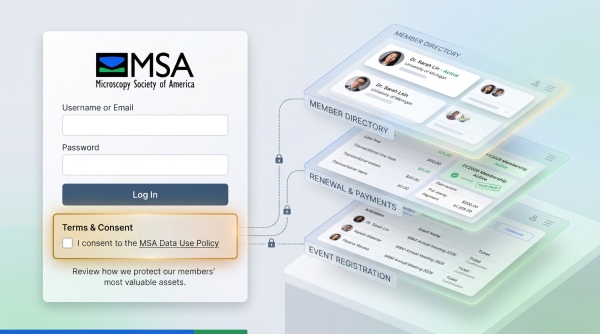
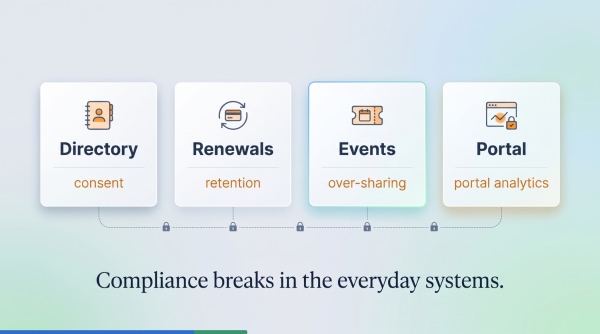
An association holds more personal data than almost any organization its size: names, contact details, payment records, employer information, event attendance, and often professional credentials, all tied to identifiable members. That member data is governed by privacy law, and which laws apply depends on who your members are and where they live. The General Data Protection Regulation (GDPR) can reach any association with members in the EU or UK. A patchwork of U.S. state privacy laws may apply depending on your structure. And the everyday systems where member data lives, the directory, renewals, event sign-ups, and the member portal, are where compliance most often breaks.
This post explains what member data compliance actually requires in 2026, which laws are likely to apply to your association, and where the gaps tend to hide. It is not a software comparison. It is about the rules that govern the data itself, and the consent, access, and handling practices that keep an association on the right side of them. We do this compliance work with membership organizations, and the same avoidable gaps appear across directories, renewals, and portals.
|
GDPR can apply to any association with members in the EU or UK, regardless of where the association is based |
4 systems where member data compliance breaks most: directory, renewals, events, and the portal |
Consent the gate that governs directory listings, marketing, and analytics on logged-in pages |
Quick answer: Association member data is governed by privacy law, and which laws apply depends on your members and your structure. GDPR can apply to any association with members in the EU or UK and requires a lawful basis for processing, clear consent, and honoring member data rights (access, correction, deletion). U.S. state privacy laws vary, and many, though not all, exempt nonprofit associations; do not assume you are exempt without checking. Compliance most often breaks in four systems: the member directory (listing members publicly without consent), renewals (retaining payment and personal data longer than needed), event sign-ups (collecting more data than necessary and sharing it), and the member portal (running marketing analytics on logged-in pages without consent). The fixes are consent, data minimization, access controls, and retention limits.
Note: This post is educational, not legal advice. Privacy obligations depend on your members' locations, your organization's structure, and the specific laws that apply. Confirm your obligations with qualified legal counsel.
Which Privacy Laws Apply to Your Association?
The laws that apply depend on who your members are and where they live, not on where your association is headquartered. An association based entirely in one U.S. state can still fall under GDPR if it has members in Europe.
GDPR is the EU's data protection regulation, and its reach is based on the location of the people whose data you process, not your own location. If your association has members, event attendees, or contacts in the European Union or the United Kingdom (which has its own UK GDPR), GDPR obligations can apply to that data. Professional and scientific associations with international membership are the most likely to be affected, and they are often the least aware of it. GDPR requires a lawful basis for processing personal data, transparency about what you collect and why, and honoring individual rights including access, correction, and deletion.
In the United States, the picture is a patchwork of state laws (California's CCPA/CPRA, and laws in Virginia, Colorado, Connecticut, and a growing list of others). A crucial nuance for associations: many U.S. state privacy laws, including the CCPA, contain exemptions for nonprofit organizations, but the exemptions are not universal and not uniform, and some associations have taxable or commercial activities that complicate the analysis. The safe posture is to confirm your status rather than assume the nonprofit label makes the laws disappear. Alongside these, sector rules apply to specific activities: CAN-SPAM (and Canada's CASL) govern marketing email, and PCI DSS governs how you handle payment card data for dues and event fees.
"The most common misconception I hear from association leaders is 'we're a nonprofit, so privacy laws don't apply to us.' That is sometimes true for a specific U.S. state law and almost never true for GDPR. If you have a single member in the EU and you process their data, the nonprofit label does not exempt you. The right move is not to guess. It is to map where your members actually are and let that determine which rules you follow."
- Brent Lafreniere, Digital Director
Reviewed by Our Team
This post draws on compliance work with membership organizations, member-data architecture, and consent and analytics configuration for logged-in member areas.
 Brent Lafreniere, Digital Director (Compliance Work with Membership Orgs) - 19 years in digital across schools, nonprofits, associations, and healthcare. Advises membership organizations on data-handling practices for directories, renewals, and portals. Provides the compliance findings in this post.
 Murad Bushnaq, CEO & Creative Director (Member-Data Architecture) - 25+ years in web design, 15+ across Morweb's four verticals. Provides the platform perspective on how member data is stored, segmented, and access-controlled.
 Steven Calibo, Digital Strategist (Consent & Analytics) - 15 years in digital strategy, Google Analytics and Google Ads certified. Configures consent and analytics for logged-in member areas so tracking does not outrun what members agreed to. Provides the consent and analytics guidance in this post.
The Member Directory: Consent Before You Publish
A public member directory publishes personal data, and publishing a member's information without their consent is one of the most common compliance failures associations make. The directory is a feature members value and a liability if it is opt-out instead of opt-in.
Member directories, searchable listings of members with names, employers, locations, and contact details, are a core association benefit. They are also a publication of personal data. Under GDPR, publishing a member's personal information generally requires a lawful basis, and consent is the cleanest one for a public listing. The failure pattern is defaulting members into the directory and making them opt out, rather than asking them to opt in and control what is shown. Members should be able to choose whether they appear at all and which fields are visible.
The stakes rise when the directory includes sensitive context or is scraped. A "Hire a Member" or public-facing professional directory exposes data to the open internet. Members should know exactly what is public, be able to change it, and be able to remove themselves. The architecture should make per-field visibility control the default, not a custom request to staff.
What to Check
- Do members opt in to the directory, or are they listed by default?
- Can members control which fields (employer, email, phone, location) are visible?
- Is any directory data exposed publicly to search engines or scraping, and do members know?
- Can a member remove themselves from the directory easily?
Renewals and Payments: Minimize and Retain Less
Renewal and dues processing generates the most sensitive member data an association holds, payment information, and the most common failure is keeping it, and everything attached to it, longer than there is any reason to.
Every renewal cycle collects personal and payment data. Two principles govern it. Data minimization means collecting only what you actually need to process the renewal, not building the largest possible profile because the form allows it. Storage limitation means keeping data only as long as you have a reason to, then deleting it. Associations routinely violate the second by retaining full payment details, lapsed-member records, and years of renewal history indefinitely, which turns a routine renewal system into a growing store of sensitive data that has to be secured and could be breached.
Payment data has its own regime. PCI DSS (the Payment Card Industry Data Security Standard) governs how card data is handled, and the safest design is to never store card numbers yourself, using a compliant payment processor so the sensitive data does not sit in your systems at all. For members subject to GDPR, retention limits and the right to deletion apply to renewal records too, which means you need a defined retention policy, not indefinite accumulation.
What to Check
- Does your renewal form collect only what is needed, or everything it can?
- Is card data handled by a compliant processor, so you never store card numbers yourself?
- Do you have a defined retention policy for lapsed members and old renewal records, or does data accumulate indefinitely?
- Can you delete a member's data on a valid request?
"On the architecture side, the goal is to hold less and control who can see it. Member data should be segmented so that the person managing events cannot necessarily see full payment history, card data should live with a compliant processor and not in the association's own database, and retention should be a policy the system enforces, not a decision someone forgets to make. You cannot lose data you never stored and cannot leak data no one has access to."
- Murad Bushnaq, CEO & Creative Director
Event Sign-Ups: Collect Less, Share Carefully
Event registration is where associations over-collect and over-share member data, gathering more than the event requires and passing attendee lists to sponsors or third parties without clear consent.
Event sign-ups tempt associations to collect broadly (dietary needs, accessibility requirements, employer, title, and more) and to reuse that data widely. Two risks follow. First, over-collection: an event form should ask for what the event needs, and sensitive fields like accessibility or dietary requirements should be handled with care and limited retention. Second, over-sharing: passing an attendee list to a sponsor, exhibitor, or partner is a disclosure of personal data that generally requires the attendee's informed consent, not a checkbox buried in the terms. Members are increasingly aware when their data is sold or shared, and an association that does it quietly risks both legal exposure and member trust.
What to Check
- Does your event form collect only what the event needs?
- Are sensitive fields (accessibility, dietary) handled carefully and not retained indefinitely?
- Do you share attendee data with sponsors or partners, and if so, do attendees clearly consent?
- Is consent for event communications separate from consent for general marketing?
The Member Portal: Consent, Access, and Analytics on Logged-In Pages
The member portal is a logged-in environment tied to a known individual, which means analytics and marketing trackers running there are recording identified member behavior, and doing that without consent is a common and overlooked violation.
On a public marketing page, analytics track anonymous visitors. On a logged-in member portal, the same analytics track a known, identified person, their logins, what they view, what they download, tied to their member record. Running standard marketing analytics or advertising trackers on portal pages without member consent can process personal data beyond what the member agreed to. Under GDPR, that requires a lawful basis and, for non-essential cookies and trackers, consent. The fix is to treat the portal differently from the public site: essential functionality only by default, and any analytics limited, consented, and configured not to capture more than necessary.
Access control is the portal's other compliance dimension. Members should see their own data; staff should see only what their role requires; and access should be logged. A portal where any administrator can view any member's full record, including payment history, is a breach waiting to happen. Segmentation and role-based access are compliance controls, not just convenience features.
What to Check
- Do marketing analytics or advertising trackers run on logged-in portal pages, and did members consent?
- Is analytics on the portal configured to avoid capturing more personal data than necessary?
- Can staff access more member data than their role requires?
- Is access to member records controlled by role and logged?
"People forget that the analytics they set up for the public website often keep running once a member logs in. The moment someone authenticates, the tracking is no longer anonymous, it is tied to a named member. That is a different consent question entirely. On member portals we scope analytics down to what is essential and consented, because measuring engagement is not worth processing identified member data the member never agreed to."
- Steven Calibo, Digital Strategist
The Association Member Data Compliance Checklist
Run this with your membership team and, where the answers are uncertain, your legal counsel. Each item maps to a system above. It is a starting audit, not a substitute for legal review.
- Map your members' locations. Determine whether you have EU/UK members (GDPR) and which U.S. state laws could apply given your structure.
- Confirm your exemption status. Do not assume the nonprofit label exempts you; verify against each law that could apply.
- Make the directory opt-in. Members choose whether to appear and which fields are visible, and can remove themselves.
- Minimize collection everywhere. Renewal and event forms ask only for what is needed.
- Keep card data with a processor. Never store card numbers in your own systems; use a PCI-compliant processor.
- Set retention limits. Define how long you keep member, renewal, and event data, and enforce deletion.
- Separate consent streams. Distinguish consent for membership, for event communications, and for marketing.
- Control portal analytics. Limit and consent any analytics on logged-in pages; do not run advertising trackers there.
- Enforce role-based access. Staff see only the member data their role requires, and access is logged.
- Honor data rights. Have a process to fulfill access, correction, and deletion requests.

Common Member Data Compliance Mistakes
The same avoidable mistakes recur across associations, and each one comes from treating member data as an asset to accumulate rather than a liability to manage.
- Assuming the nonprofit label exempts you. It is sometimes true for a specific state law and almost never true for GDPR. Verify, do not assume.
- Defaulting members into the public directory. Opt-out directories publish personal data without meaningful consent.
- Keeping everything forever. Indefinite retention of renewal and payment data turns a normal system into a growing breach risk.
- Running public-site analytics inside the portal. Tracking a logged-in member is a different consent question than tracking an anonymous visitor.
- Sharing attendee lists quietly. Passing event data to sponsors without clear consent erodes both compliance and member trust.
- Giving all staff full access. Unsegmented access to member records is a breach waiting to happen.
Association Member Data Compliance: Common Questions
Does GDPR apply to a U.S.-based association?
It can. GDPR's reach is based on the location of the people whose data you process, not where your association is headquartered. If you have members, event attendees, or contacts in the EU or UK and you process their personal data, GDPR obligations can apply, regardless of your U.S. location or nonprofit status. Associations with international membership are the most likely to be affected. Confirm your specific obligations with counsel.
Are nonprofits and associations exempt from CCPA and state privacy laws?
Sometimes, but not universally. Many U.S. state privacy laws, including California's CCPA, contain exemptions for nonprofit organizations, but the exemptions differ by law and some associations have activities that complicate the analysis. Do not assume the nonprofit label makes every privacy law inapplicable. Check each law that could apply given your members and your structure, and confirm with counsel.
Can we list members in a public directory by default?
It is risky. Publishing a member's personal information generally requires a lawful basis, and for a public directory, opt-in consent is the cleanest approach. Defaulting members in and requiring them to opt out publishes personal data without meaningful consent. Best practice is to let members choose whether to appear at all, control which fields are visible, and remove themselves easily.
How long can we keep member and payment data?
Only as long as you have a legitimate reason to. Two principles apply: collect only what you need (data minimization) and keep it only as long as necessary (storage limitation). Indefinite retention of lapsed-member records and payment history is a common failure. Define a retention policy, delete data when the reason to hold it ends, and never store card numbers yourself, use a PCI-compliant processor instead.
Do privacy rules apply to analytics on our member portal?
Yes, and more strictly than on public pages. Once a member logs in, analytics are tracking an identified individual, not an anonymous visitor, which is a different consent question. Running standard marketing analytics or advertising trackers on logged-in portal pages without consent can process personal data beyond what members agreed to. Limit portal analytics to what is essential and consented, and do not run advertising trackers there.
What is the fastest way to reduce our member data risk?
Hold less and control access. Make the directory opt-in, minimize what your forms collect, keep card data with a compliant processor instead of in your own systems, set retention limits so data does not accumulate forever, and enforce role-based access so staff see only what they need. Each step reduces both the amount of sensitive data you hold and the number of people who can reach it.
More on managing membership and member data:
Membership Management Software: What Associations Actually Need. What to look for when membership, events, and member data need to work together, the operational companion to this compliance post.
Association Management Software Explained. How the systems that hold member data fit together, and what "member data architecture" means in practice.
Website Vendor Red Flags Before You Sign. Vendor due diligence for member data, including data portability and whether a vendor will sign the agreements you need.

Do you know where your member data is exposed?
Our team will review how your directory, renewals, event sign-ups, and member portal handle personal data, and give you a plain-language findings list mapped to the systems in this post. A starting audit to bring to your counsel, not legal advice. No pitch unless you ask for one.