

Answer 18 quick questions and get a personalized trust score — plus clear, prioritized recommendations to strengthen your website’s mission clarity, impact, and transparency.
Not because most nonprofits are doing anything wrong but because a small number of high-profile cases have reminded donors, boards, and the public how important clarity and transparency are. Recent fraud cases in Minnesota, for example, involved a limited number of organizations, yet they sparked broader conversations about expectations across the nonprofit sector.
For many nonprofit leaders, this has translated into a noticeable shift. Stakeholders are asking more thoughtful, informed questions about how organizations communicate their mission, demonstrate impact, and steward donated funds.
The common thread isn’t suspicion, it’s heightened expectation. People want to quickly understand:
- Who you serve
- Why your mission matters
- What impact you’re having
- How donated funds are used
This moment isn’t about defensiveness. It’s an opportunity for nonprofits doing meaningful, ethical work to clearly demonstrate who they are, what they do, and how they build trust.
In the wake of recent nonprofit fraud cases in Minnesota and growing political scrutiny around charitable oversight, many organizations are realizing that trust can no longer be assumed, it must be clearly demonstrated.
- Murad, CEO/Creative Director of Morweb
Why This Matters Right Now for Nonprofit Websites
Across the nonprofit landscape, leaders are noticing subtle but important shifts, not because trust has disappeared, but because expectations have changed. The broader political conversation around nonprofit oversight have increased public attention on how organizations explain their mission, impact, and use of funds. While these cases involve a small number of bad actors, they have shaped how donors, boards, and the public think about accountability across the sector.
This has created a new reality for nonprofit leaders: being trustworthy is no longer enough, organizations must be visibly trustworthy.
- Donors want clearer explanations of impact. Not just what you do, but what actually changes because of it.
- Boards are asking more strategic questions about transparency. How easily can someone understand our financial stewardship and governance?
- Staff want confidence in how the organization communicates accountability. Especially when representing the organization to partners, funders, and the community.
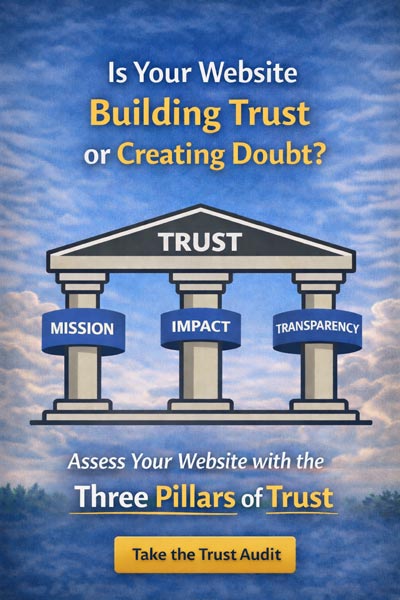
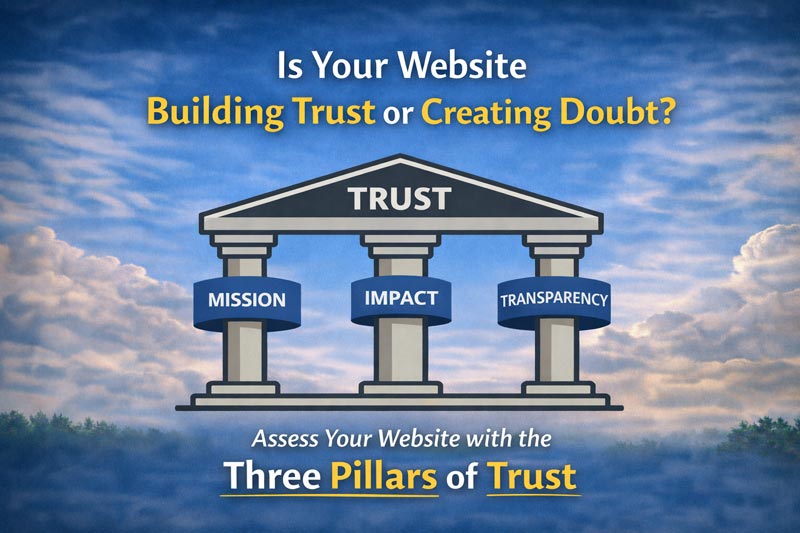
The 3 Pillars of Trustworthy Nonprofit Website Communication
Strong nonprofit websites are built on three foundational pillars. When these are in place, transparency feels natural, credible, and consistent.
Pillar 1: Mission First — Clear, Current, and Easy to Understand
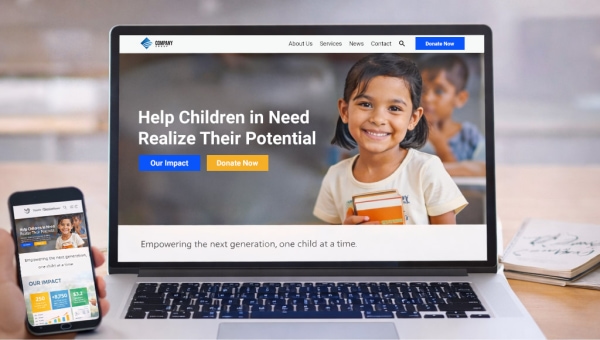
Trust starts with understanding.
One of the most important questions nonprofit leaders can ask is whether their mission statement still reflects what the organization actually does today. As programs evolve, mission statements can become outdated, overly complex, or disconnected from day-to-day work.
A mission-first nonprofit website includes:
- A mission statement that accurately reflects current work
- Simple, plain-language messaging that avoids internal jargon
- A clear elevator pitch that explains what you do in one or two sentences
- A short, memorable slogan or tagline that reinforces your purpose
- Clear language about who you serve
- A brief origin story or “aha moment” that explains why your organization exists
When visitors can quickly understand your mission and remember it, trust builds naturally. For more practical guidance on reviewing and updating content, see: Expert Nonprofit Website Design Tips: Content Migration, Optimization and Content Update Guide.
Pillar 2: Impact You Can See, Understand, and Track Over Time

Donors and stakeholders want to see progress, not just promises.
Effective nonprofit impact reporting goes beyond numbers alone. It uses real images, stories, and data together to show how the mission is coming to life.
Strong impact communication includes:
- Real photos showing your work in action (not stock imagery)
- Impact metrics clearly aligned with organizational goals and mission
- Visual storytelling that combines data with human outcomes
- Progress indicators that show results over time (year-over-year metrics, milestones, growth)
- Clear explanations of what success looks like and why it matters
- An option to request additional impact details or reports
- A named contact person for impact-related questions
When people can see real progress and understand how it’s measured, confidence grows. If you’re looking for inspiration, explore: 30 Best Nonprofit Websites + 5 Tips For Designing Your Own.
Pillar 3: Transparent and Humanized Financial Stewardship

Financial transparency builds trust long before a donation is made.
Today’s nonprofit websites benefit from making financial information both accessible and human. Transparency isn’t just about compliance, it’s about clarity and accountability.
Strong financial transparency includes:
- Easy-to-find financial summaries, annual reports, or Form 990s
- Charts or graphics that clearly show how funds are allocated
- Plain-language explanations of financial data
- Up-to-date reporting and documentation
- Photos or brief bios of leadership, finance staff, or board members involved in oversight
Free Interactive Trust Audit
Is your nonprofit website building trust—or creating doubt?
Answer 18 quick questions and get a personalized trust score plus clear, prioritized recommendations to strengthen your website’s mission clarity, impact, and transparency.
Start the Interactive Trust Audit
Takes about 5 minutes • Designed for nonprofit leaders, marketing teams, and board discussions
A Real-World Example: The Dayton Foundation
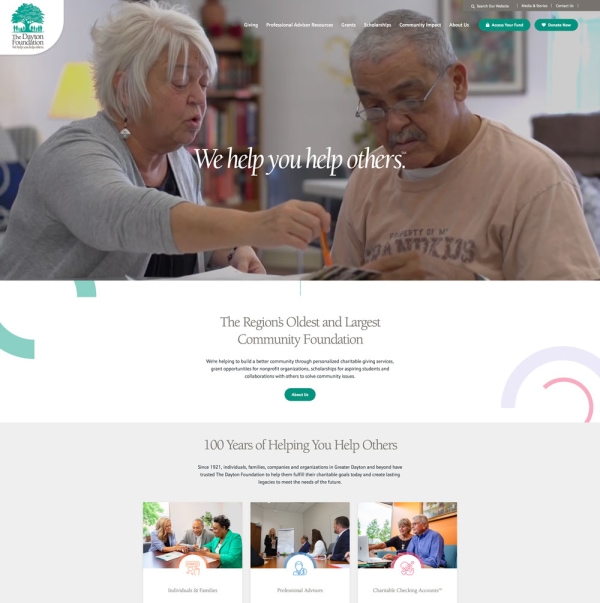
A strong example of one of Morweb's strategy-led nonprofit website is The Dayton Foundation, a long-established community foundation that clearly structures its online presence around mission, impact, and transparent stewardship.
From the moment you arrive on their homepage, the organization communicates a clear purpose: helping donors create lasting impact in the Greater Dayton region through philanthropy and community leadership. The language is plain, confident, and immediately answers the question, “What do you do, and who is this for?”
The site reinforces this clarity with visible indicators of impact including the scale of funds stewarded, grants awarded, and community initiatives supported, helping visitors quickly understand both scope and credibility.
Transparency is also treated as a first-class experience. The Dayton Foundation makes annual reports, audited financials, and Form 990s easy to find and easy to understand. Financial data is paired with context and storytelling, allowing donors and stakeholders to see not just the numbers, but the outcomes those numbers support.
Importantly, the website doesn’t feel overwhelming or overly technical. Technology stays in the background while strategy leads:
-
Mission clarity comes first
-
Impact is visible and tied to community outcomes
-
Financial stewardship is proactive and human
This approach was recognized in 2024, when Morweb and The Dayton Foundation website received a “Best Nonprofit Website” award from the WE Awards, highlighting the effectiveness of strategy-driven design, clear communication, and trust-building transparency.
When strategy leads and technology supports it, a nonprofit website becomes more than a digital presence. It becomes a trusted extension of the organization’s mission.
FAQ: Nonprofit Website Transparency and Trust
What is website transparency for nonprofits?
Website transparency for nonprofits means clearly communicating your mission, impact, and how funds are used in a way that’s easy for donors, boards, and the public to understand.
How can nonprofits build donor trust online?
Nonprofits build donor trust online by simplifying mission messaging, using real impact proof (stories + data), and making financial stewardship information easy to find and understand.
What is a nonprofit website audit?
A nonprofit website audit is a structured review of your site’s content and user experience often focusing on mission clarity, impact communication, and transparency so you can identify what to improve first.
What should nonprofits prioritize first: design or content?
Content and strategy should come first. Design and technology should support your messaging, helping visitors quickly understand your mission, trust your impact, and feel confident taking action.
Ready to take the next step?
If you’d like a second set of eyes on your website, we’re here to help. Schedule a 1-on-1 strategy session with one of our nonprofit strategy experts to review your results and identify practical opportunities to strengthen trust and confidence.
✔ No pressure ✔ No obligation ✔ Just clear, strategic guidance
Schedule a 1-on-1 Strategy Session
Related Morweb Resources
- Nonprofit Homepage Best Practices
- Nonprofit Website Engagement: What’s Going Wrong?
- Expert Nonprofit Website Design Tips
- 10 Nonprofit Web Design Best Practices To Maximize Support
- 30 Best Nonprofit Websites + 5 Tips
- Why and When Nonprofits Should Redesign Their Websites
 Takes about 5 minutes • Designed for nonprofit leaders, marketing teams, and board discussions.