

Most associations do not start with association management software. They start with a spreadsheet of members, a separate tool for dues, an email platform, an events form, and a website that knows nothing about any of it. It works until it doesn’t — usually around the point where renewals get missed and one staff member is quietly holding the whole thing together by hand.
This guide explains what association management software actually is, the features that genuinely matter (and the ones vendors oversell), and what different kinds of associations really need. It is not a ranked list of products. A ranking cannot tell a 200-member local society and a 30,000-member national trade association what to buy, because they should not buy the same thing.
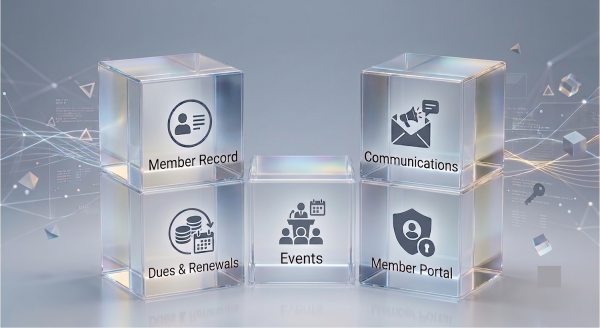
5 core jobseverything an AMS does reduces to five: member record, dues, events, communications, portal |
4 typesof association have genuinely different needs — trade, professional society, multi-chapter, and small club |
1 truththe best-known product is not the best fit; fit beats feature count every time |
Quick answer: Association management software (AMS) is a platform that stores member records and runs the core work of membership — dues and renewals, event registration, communications, and a logged-in member portal — in one connected system instead of scattered tools. The right AMS depends on the type and size of your association, not on which product tops a list. Focus on the five jobs an AMS actually does, ignore the features you will never use, and treat how it connects to your website as a core requirement.
What Is Association Management Software?
Association management software is the system of record for your members and everything they do with you.
An AMS replaces the patchwork most associations start with. Instead of a membership spreadsheet, a payment tool, an email service, an events platform, and a disconnected website, an AMS holds it in one place so the data stays consistent. When a member renews, the record updates everywhere. When they register for your conference, it ties back to their profile. That single source of truth is the whole point.
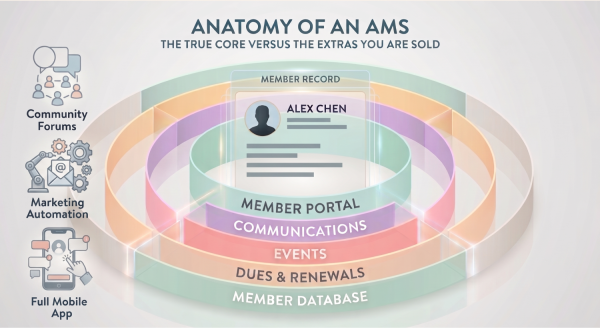
Strip away the marketing and every AMS does five things. Judge any product on how well it does the two or three that matter most to you, not on the length of its feature list.
- Holds the member record — contact details, membership type, join date, and status, in one authoritative place.
- Runs dues and renewals — automated invoices, reminders, grace periods, and self-service renewal.
- Manages events — registration, member and tiered pricing, and attendance tied to the member record.
- Handles communications — segmented email to members, committees, chapters, or lapsed members.
- Powers a member portal — a logged-in area where members update their profile, pay, register, and reach member-only content.
Everything else an AMS advertises — community forums, marketing automation, learning management, a mobile app — is built on top of those five. Useful for some associations, irrelevant for many.
Reviewed by Our Team
This guide reflects firsthand work building the websites and member portals that sit on top of these systems — so it is grounded in what each tool does once real staff and real members use it, not in vendor demos.
 Murad Bushnaq, CEO & Creative Director (Strategy, UX & Platform) — 25+ years in web design, 15+ focused on nonprofits, schools, associations, and healthcare. Founded the Morweb CMS and has guided 500+ sites for organizations including the Microscopy Society of America, United Way, and Engineers Without Borders USA. Works from a simple rule: strategy before technology.
 Brent Lafreniere, Digital Director (UX, Integrations & Strategy) — 19 years in the mission-driven CMS space across nonprofits, schools, associations, and healthcare. Specializes in connecting member databases to websites without creating duplicate data entry, plus UX, accessibility, and SEO.
 Bita Goli, Senior Designer (Member UX & Design) — 5+ years in UX, typography, and visual design across all four of Morweb’s verticals. Focuses on how members actually move through renewal, registration, and portal flows.
 Steven Calibo, Digital Strategist (Analytics & SEO) — 15 years in digital strategy across all four verticals. Google Analytics, Google Ads, HubSpot, and CRO certified. Looks at where members drop off in renewal and registration flows.
The Features That Actually Matter (and the Ones Vendors Oversell)
Feature lists are designed to make every product look complete. The skill is knowing which features earn their keep for an association like yours.
In our work with associations, the features that drive real value are boring and foundational. The features that win demos are often the ones that go unused six months later. Here is how we sort them.
|
Feature |
Verdict |
What to actually check |
|
Member database |
Non-negotiable |
Custom fields, membership types, history. This is the foundation everything else relies on. |
|
Dues & renewal automation |
Critical |
Automated reminders, grace periods, and self-service renewal. Manual renewals do not scale. |
|
Integrations / open API |
Critical |
How it connects to your website and accounting. “We have an API” is not an answer — ask what syncs and how. |
|
Member portal / self-service |
High value |
Members updating their own profile, paying, and registering reduces staff load more than any other feature. |
|
Event registration |
Depends |
Essential if events are core to you; minor if you run one or two a year. Match it to your calendar. |
|
Reporting & analytics |
High value |
Can non-technical staff actually pull the report? Power you cannot use is not power. |
|
Online community / forums |
Often oversold |
Low adoption unless you already have an engaged base. Do not buy a tool for the forum alone. |
|
Marketing automation |
Oversold for small orgs |
Valuable at scale; overkill for a few hundred members. Most small teams never configure it. |
|
Learning management (LMS) |
Niche |
Only matters if you sell courses or certifications. Otherwise dead weight you pay for. |
|
Dedicated mobile app |
Usually oversold |
Most members use the website on their phone. A good mobile site beats a rarely-downloaded app. |
“Associations get sold on the feature that demos well — a community platform, a slick app — and underweight the boring things that decide whether the system works: clean member data, automated renewals, and a real connection to the website. Six months in, nobody is using the forum, but everyone is still fighting the renewal flow.”
— Murad Bushnaq, CEO & Creative Director
What Different Associations Actually Need
The right software depends far more on the kind of association you are than on any product’s ranking. Find your type first.
Associations are not interchangeable. A trade association billing corporate members is solving a different problem than a volunteer-run society collecting flat dues. Here is what each type should prioritize, and the kinds of tools built for it.
|
Type |
What makes it different |
Prioritize |
Tools built for it |
|
Trade association |
Corporate memberships with individual sub-members, tiered dues, restricted directories |
Multi-tier permissions, corporate billing, professional directories |
NetForum, iMIS, Aptify, Novi AMS |
|
Professional society / certification body |
Continuing education, certifications, journals, individual members |
Certification tracking, LMS, member directory, event-heavy tools |
iMIS, Nimble AMS, YourMembership, NetForum |
|
Multi-chapter / national |
Local chapters that need autonomy plus headquarters oversight |
Chapter management, roll-up reporting, shared-but-separate data |
Memberplanet, Fonteva, NetForum |
|
Small / volunteer-run club |
A few hundred members, simple dues, no dedicated staff |
Affordable all-in-one, ease of use, no developer required |
Wild Apricot, ClubExpress, StarChapter, MemberClicks |
|
Alumni / education |
Large, loosely engaged base; events and giving |
Community engagement, peer-to-peer fundraising, directory |
Almabase, Salesforce, Graduway |
|
Highly custom / technical |
Unusual data model, in-house technical capacity |
Flexibility and control over hosting and customization |
CiviCRM (open source) |
How to use this table: find your row first, then evaluate only the tools in that lane. Most association software regret comes from buying out of your lane — a small club in an enterprise AMS it cannot staff, or a national association on a tool that cannot model chapters.

Where Your Website Fits (and Why Morweb Is the Portal, Not the Database)
Your member database and your website are two different things, and the connection between them is where most associations feel daily pain.
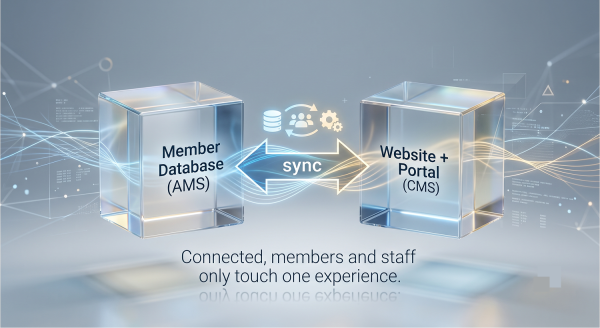
An AMS holds your member data. Your website and member portal are what members and prospects actually see and use. Some lightweight platforms bundle a basic website into the AMS; larger associations usually run a dedicated content management system (CMS) for the public site and connect it to the AMS that holds the data. Both can work. What does not work is treating the website as an afterthought.
We build that website and portal layer. To be clear about what Morweb is: it is a CMS with membership, events, and member-portal modules — not an enterprise member database. For smaller associations, Morweb can be the whole stack. For larger ones running a dedicated AMS, Morweb is the professional public site and member portal that connects to it, so members get one clean experience and staff stop re-entering data in two systems. The single most common, most expensive problem we see is a strong member database behind a disconnected website, forcing staff to re-key data and pushing members through a confusing renewal handoff.
That is also why one all-in-one tool is not automatically the answer. The honest trade-off is “all-in-one versus best-of-breed”: an all-in-one platform is simpler but limited; a best-of-breed AMS plus a dedicated website is more capable but only if the two connect cleanly. We work through that exact decision in our companion guide on how to choose association management software by size and structure.
We build sites and portals for associations like the American Association for Homecare, the Microscopy Society of America, and the Greater New York Automobile Dealers Association — groups where the website is not a brochure but the place members renew, register, and transact. In every case the question is the same: how cleanly does the site members live on connect to the system that holds their data.
How to Evaluate Without Getting Oversold
Vendor demos are built to impress. A short, disciplined evaluation keeps you focused on what matters and surfaces the red flags.
You do not need a 40-row scorecard. You need to pressure-test the few things that actually predict whether the system will serve you. Watch for these red flags during any AMS sales process:
- The demo only shows the admin view. Make the vendor show a member renewing and registering for an event from the public website, end to end. That member path is what retains people, and it is the thing demos quietly skip.
- “We integrate with everything.” Ask exactly what data syncs between their system and your website, in which direction, how often, and what it costs. Vague integration answers become expensive surprises.
- Pricing without the extras. Get implementation fees, per-transaction charges on dues and event payments, and the cost of additional staff logins in writing. The sticker price is rarely the real price.
- No clear data-export answer. Ask how you get your member data out if you leave, and in what format. If that answer is fuzzy, you are looking at lock-in.
- Feature dazzle over your actual needs. If the pitch leans on a community platform or app you did not ask for, redirect to your ranked five jobs.
For the full step-by-step process — matching a software category to your association’s size and structure before you compare individual products — see our companion guide on choosing association management software.
Association Management Software: Common Questions
What is association management software?
Association management software (AMS) is a platform that stores member records and runs the core work of membership: dues and renewals, event registration, communications, and a logged-in member portal. It replaces the spreadsheets, separate payment tools, and manual processes most associations start with by putting member data in one connected system.
What is the difference between an AMS and a CRM?
An AMS is purpose-built for member-based organizations, so dues, renewals, chapters, and certifications are native. A CRM is built primarily to manage relationships and, in the nonprofit world, donations. A CRM can be stretched to handle membership, but the membership mechanics are usually an add-on rather than the core. Choose an AMS when membership structure is complex; consider a CRM when fundraising matters as much as dues.
What features should an association management system have?
At minimum: a flexible member database, automated dues and renewals, event registration tied to member records, segmented communications, and a self-service member portal. Just as important is a real integration with your website and accounting system. Features like community forums, marketing automation, learning management, and mobile apps are valuable for some associations and unused dead weight for others — buy them only if you will use them.
What is the best association management software?
There is no single best option, and any ranking that names one is ignoring how different associations are. The right choice depends on your type and size. Small volunteer-run clubs are well served by lightweight all-in-one platforms like Wild Apricot or ClubExpress; trade associations and professional societies with complex membership need a dedicated AMS like NetForum, iMIS, or Aptify; multi-chapter groups need chapter-aware tools like Memberplanet or Fonteva. Find your type first, then compare the tools built for it.
Is Morweb an association management system?
Morweb is a content management system with membership, events, and member-portal modules — the website and portal layer members actually use. For smaller associations it can serve as the full stack. For larger associations running a dedicated AMS, Morweb is the professional public website and member portal that connects to it, so staff avoid duplicate data entry and members get one clean experience. It is the portal, not the enterprise member database.
How much does association management software cost?
Pricing ranges from affordable monthly subscriptions for lightweight platforms to five- and six-figure annual costs for enterprise systems, often plus one-time implementation fees. We do not publish specific figures because vendor pricing in this category changes often and most lists quote outdated numbers. When you evaluate, get current pricing in writing and ask about implementation, per-transaction fees on dues and events, extra staff logins, and the cost to export your data.
Working out your association software stack? These related guides go deeper on the pieces around your member system:
Choosing Association Management Software: A Decision Guide by Size and Structure. The companion to this pillar — how to match a software category to your association.
The Best Association Websites: What the Strong Ones Do Differently. See how leading associations structure their public site and member experience.
Membership Website Builders: How to Choose the Right Platform. A closer look at the website and portal layer that sits on top of your member data.
Ready to see how your website and member system should work together?
Whether you run a dedicated AMS or want one platform to do it all, we build association websites and member portals that connect cleanly to your member data — so your staff stop re-entering information and your members stop dropping out of renewal. We can review your current setup and show you where the gaps are.